
A familiar Monday for a finance lead at a 100-person company: cash looks fine on paper, the bank balance does not, and the gap is a handful of invoices that were due two, five or ten weeks ago. Nobody decided to let them slide. Each one waited for someone else to make the call.
This month the European Commission made it clear that no new EU law will fix this for you soon. The useful response is a routine of your own.
In short: chasing overdue invoices works when it runs every week from one aged receivables report, with a fixed ladder of steps (reminder, phone call, formal notice, hold) and a named owner for each step. In the Netherlands you can charge statutory commercial interest of 10.4% a year since 1 July 2026, plus at least €40 per late invoice, and you do not have to send a free reminder to a business customer first.
What changed in Brussels this month?
In September 2023 the Commission proposed a Late Payment Regulation with a strict 30-day maximum payment term for business-to-business invoices. On 4 November 2026 it published its 2027 work programme. The annex lists that proposal among those it plans to withdraw: it has been pending for more than three years and "a sizeable number of Member States" oppose further work on it.
It is not formally withdrawn yet, as trans.info reported on 19 November, and the current EU late payment directive and the national rules built on it stay in force. For a finance lead the practical reading is short: the rules you have today are the rules you will work with for the next few years.
How late do European customers actually pay?
Late by about three weeks, on average. Intrum's European Payment Report 2026, based on 8,385 executives in 20 countries, found that business customers get 43 days to pay on average and take 63. Public-sector buyers get 53 days and take 70. The same report says 62% of businesses pay their own suppliers late because their customers paid them late, so one slow payer spreads down the chain.
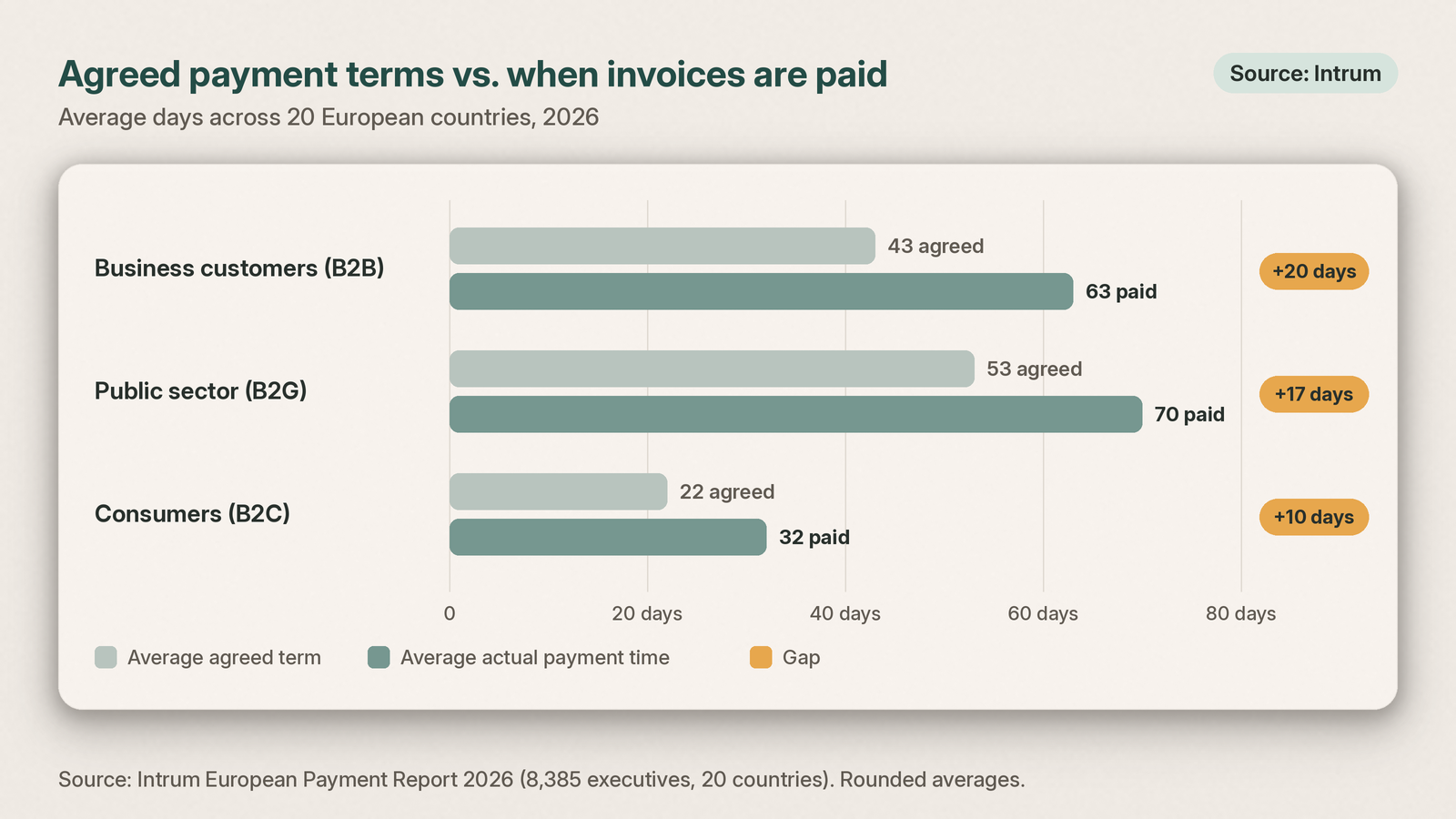
Source: Intrum, European payment trends 2026. Rounded averages across 20 countries.
Dutch numbers point the same way. In the Exact MKB Barometer 2026, a survey of 1,719 Dutch SMEs, respondents said 15% of their invoices are paid late and 3% are never paid. Getting customers to pay on time was the most named challenge in their financial administration. With company bankruptcies in October 27% higher than a year earlier according to CBS, an invoice that sits at 90 days is a bigger risk than it was last year.
What can you charge a late-paying customer in the Netherlands?
More than most teams ask for. The government's business portal Ondernemersplein sets out the main rules, and Rijksoverheid publishes the interest rate.
| Rule | What it means for you |
|---|---|
| No payment term agreed | The term is 30 days |
| Maximum B2B term | 60 days, unless agreed otherwise and not unfair to either side |
| Large company paying an SME | Must pay within 30 days |
| Statutory commercial interest | 10.4% a year since 1 July 2026, from the day after the due date |
| Fixed compensation | At least €40 per late invoice, on top of interest |
| Reminder first? | Not required for business customers (it is for consumers) |
A worked example, not a customer case: a €12,000 invoice paid 30 days late carries about €102.58 in statutory interest (€12,000 × 10.4% × 30/365), plus €40. Small on one invoice, but mentioning it changes how a customer's accounts payable team ranks yours.
Whether you charge it is a commercial call. A middle route: state it in the formal notice and waive it if the customer pays by the new date. Check your general terms with your lawyer or accountant before you change your letters.
What does a weekly collections routine look like?
One meeting, one report, and a ladder that every overdue invoice climbs until it is paid. Here is an example that works for a 50–200 person B2B company:
- Monday morning, finance: reconcile the bank first, so paid invoices drop off the list. Then pull the aged receivables report.
- Due date: nothing to send if the bank shows the payment. If not, the invoice joins the list.
- +3 days, finance: a short reminder email with the invoice attached and the payment details repeated.
- +10 days, account owner: a phone call to the person who approves payment, not the general inbox. Ask for a date and write it down.
- +21 days, finance lead: a formal notice with a final date, the statutory interest and the €40 compensation.
- +35 days, finance lead and sales: hold new orders or new work and decide on a collection agency or lawyer.
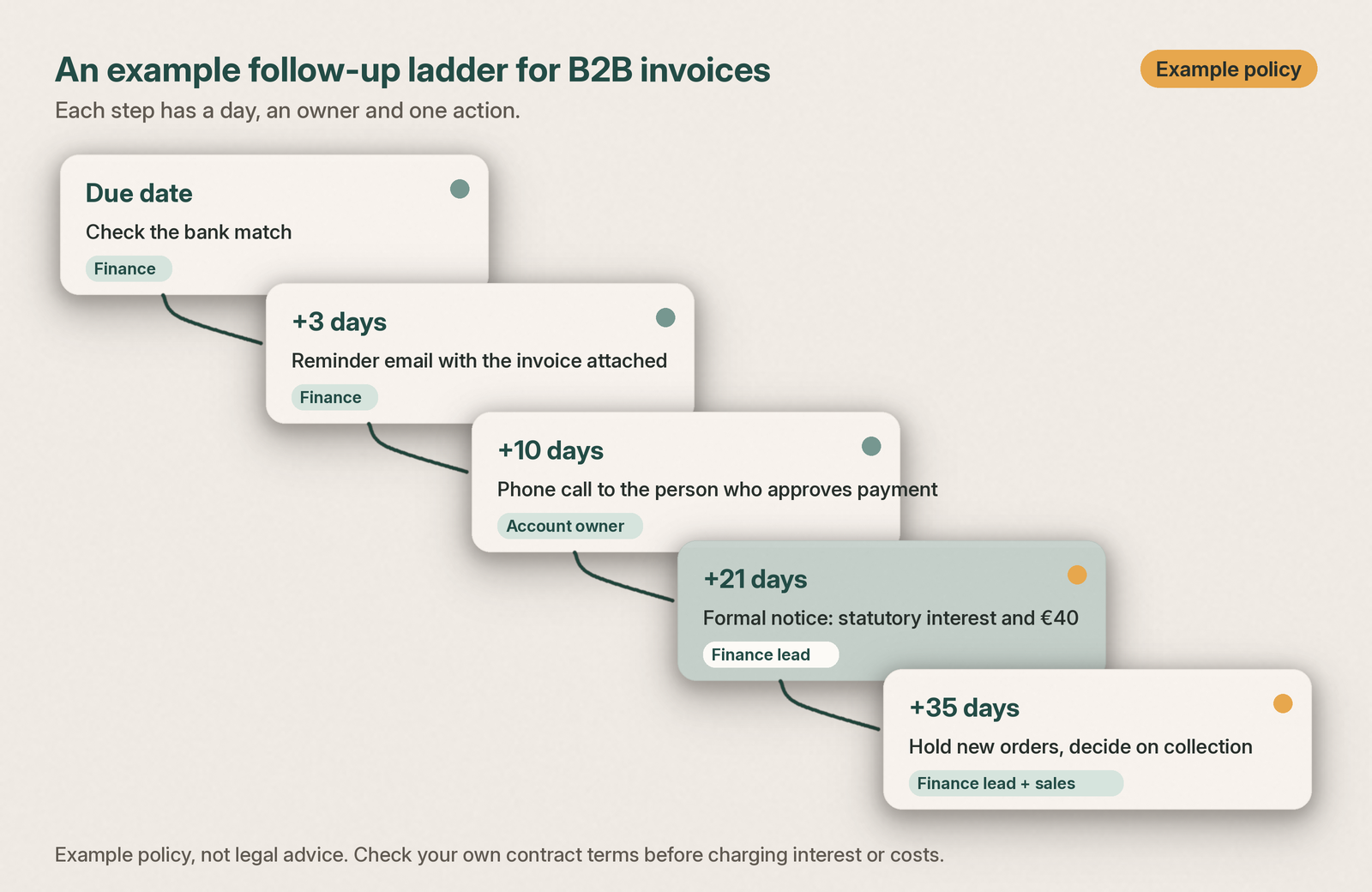
An example policy, not legal advice. Adjust the days to your own payment terms.
The days matter less than two habits: every step has one owner, and the call at +10 days comes from the person who owns the customer relationship. A call from the account manager is harder to ignore than a fourth email from finance.
Which report should you work from?
The aged receivables report. It lists every open customer invoice by how many days it is past due, usually in buckets of 1–30, 31–60, 61–90 and over 90 days, with one row per customer. Work it from the right: the oldest money first, then the largest amounts.
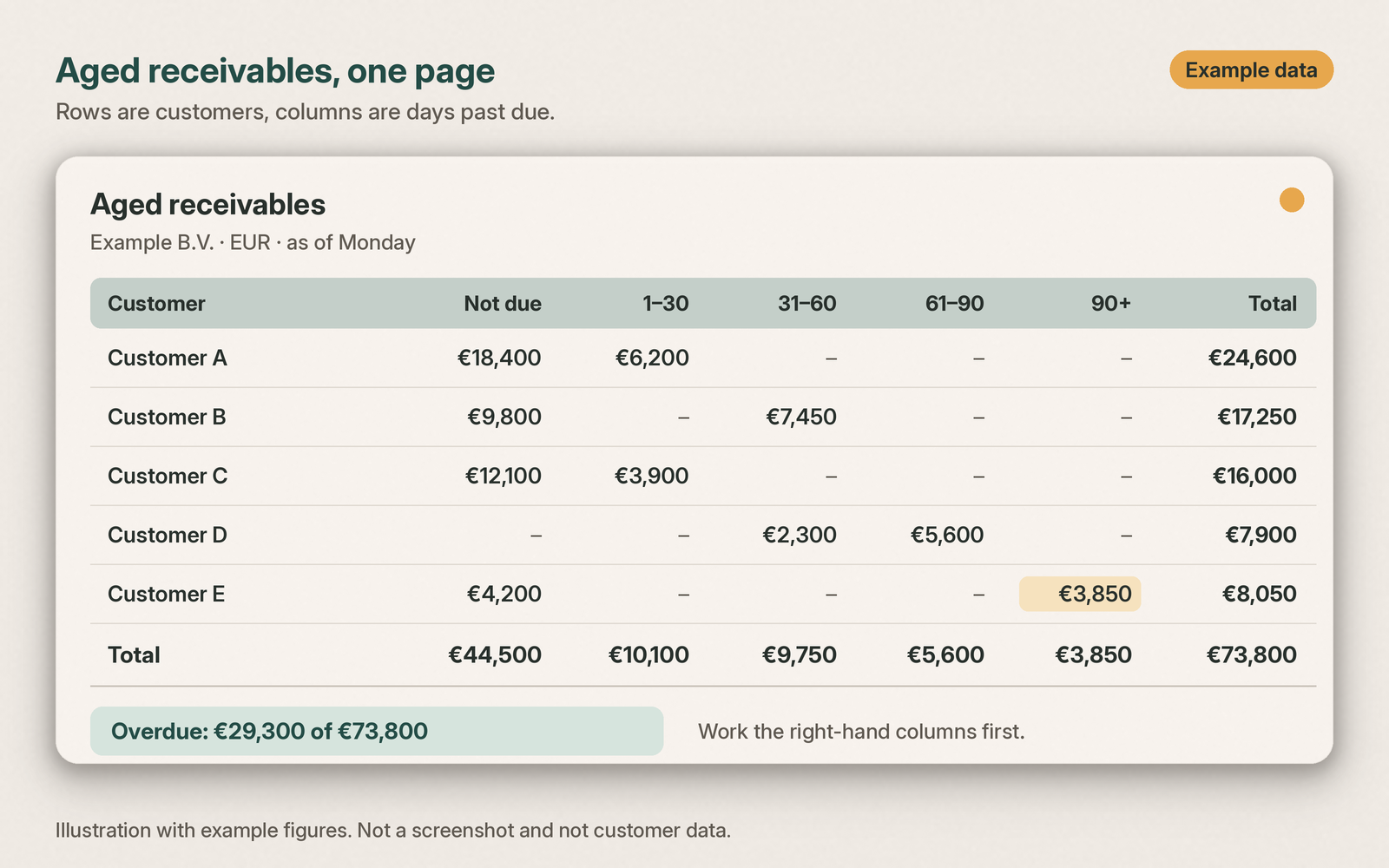
Illustration with example figures. Not a screenshot and not customer data.
Two checks keep the report honest. Reconcile the bank first, because an unmatched payment makes a paid invoice look overdue (see our guide to weekly bank reconciliation). And look for disputes: an invoice waiting for a credit note needs a fix from your side, not a reminder.
What should a payment reminder include?
Everything the customer's accounts payable clerk needs to pay without asking you a question:
- The invoice number, date, amount and due date in the first two lines
- The invoice attached again as a PDF
- Bank details and the payment reference you want them to use
- The purchase order number, if the customer works with POs
- One named contact at your side, with a direct phone number
- From the formal notice on: the final date, the statutory interest and the €40 compensation
Keep the tone flat and factual. A late invoice is often stuck in a queue or waiting for an approval at the customer. The reminder's job is to move it up.
Where does Klarora by Kairos fit?
Klarora by Kairos is an all-in-one workspace for tasks, docs, chat and CRM, with Finance as an add-on for invoicing, bank feeds and the general ledger. Several parts of it map onto the routine above.
The Finance Home shows receivables with the overdue amount and a "needs attention" count of overdue invoices. Bank feeds through Tink or MT940 import are matched daily, so payments that have arrived drop off the overdue list before anyone picks up the phone. The Week 48 release added an approval step for customer invoices with a Home card for what waits on you, which helps when wrong invoices are the reason customers do not pay.
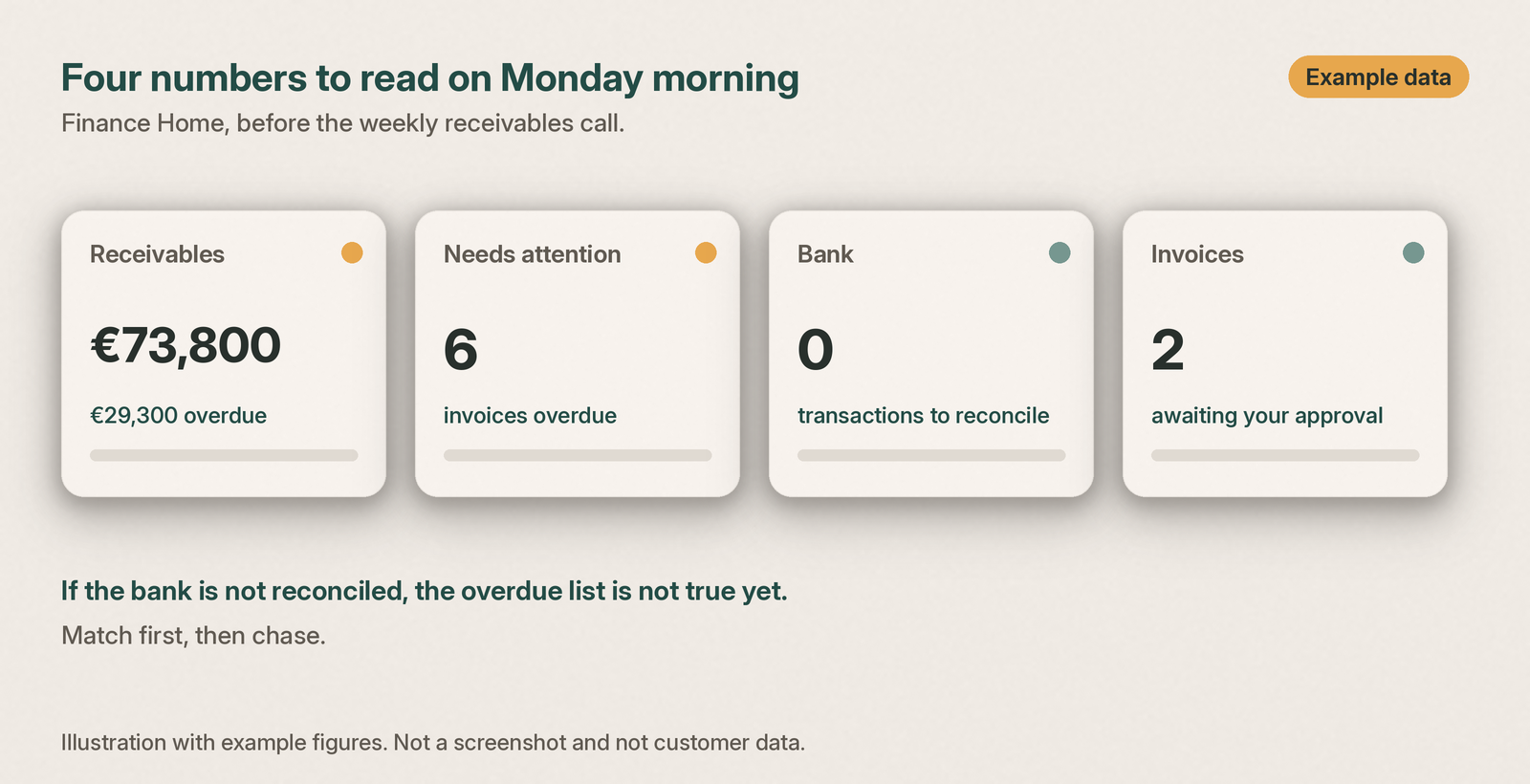
Illustration with example figures. Not a screenshot and not customer data.
The aged receivables report is one of the standard Finance reports. You can also ask the assistant "who owes us money?" and get the answer from the ledger, and because customers in Finance are your CRM companies, the account owner sees the same invoices on the company record before making the call.
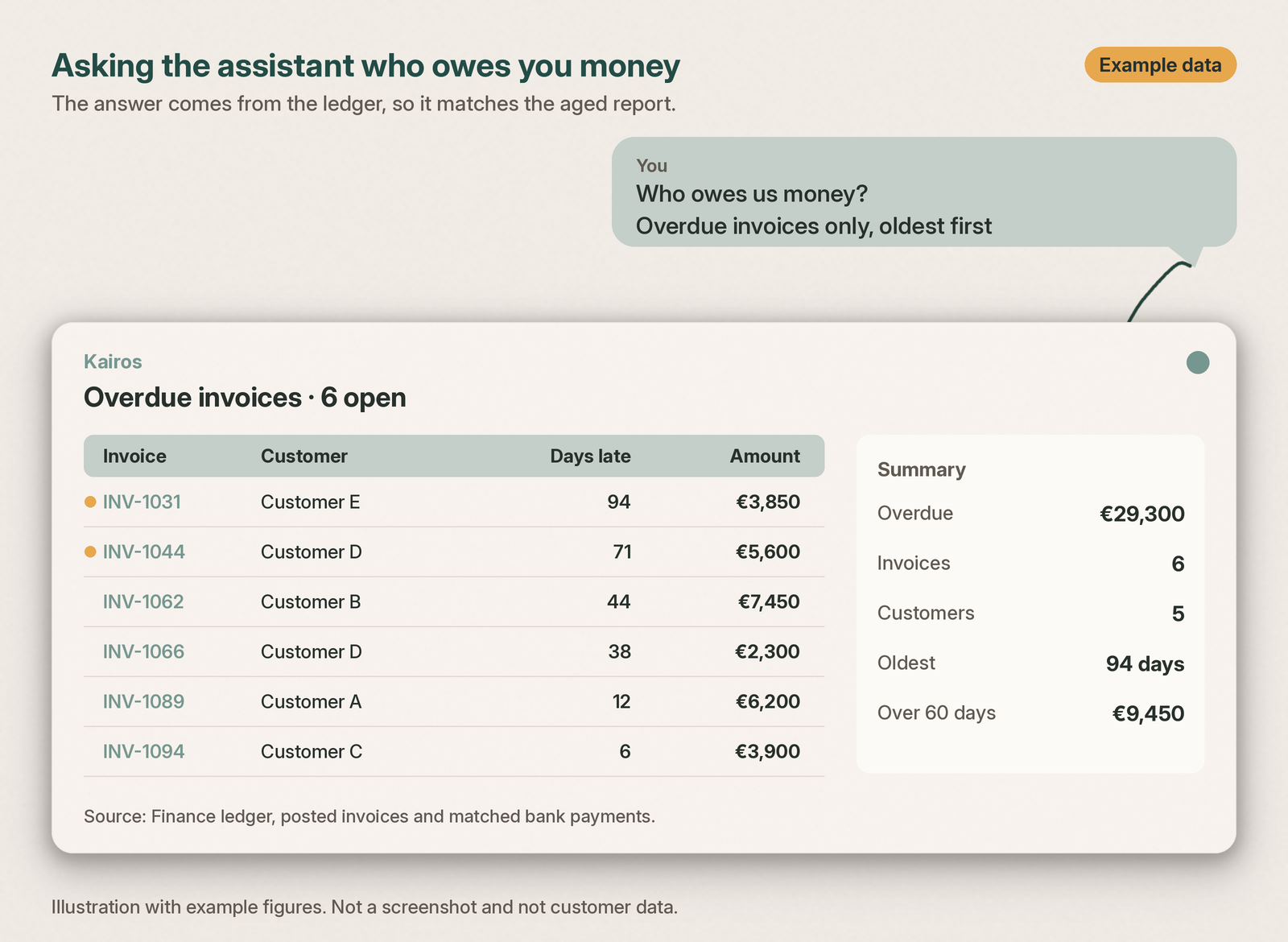
Illustration with example figures. Not a screenshot and not customer data.
Klarora does not decide whether you charge interest, and it does not replace your lawyer or a collection agency at step six. It keeps the list, the bank and the customer history in one place so the Monday meeting starts from the same numbers. If invoices go out late or wrong in the first place, read how to fix the handoff from deal to project to invoice and how to set up invoice approvals without chat.
Frequently asked questions
How soon should you chase an overdue invoice?
Within a few days of the due date. The example ladder above sends a reminder at three days late, calls at ten and sends a formal notice at three weeks. Waiting until month end costs you a month.
What is the statutory commercial interest rate in the Netherlands in 2026?
10.4% a year since 1 July 2026, according to Rijksoverheid. It runs from the day after the due date until the day the customer pays.
Can I charge €40 on every late invoice?
For business customers in the Netherlands, yes: Ondernemersplein lists a standard compensation of €40 for a late invoice, on top of interest and reasonable collection costs. Your contract can set different terms, so check it first.
Is the EU 30-day payment term law still coming?
Not soon. The Commission's 2027 work programme lists the proposed Late Payment Regulation for withdrawal. Until it is formally withdrawn the file stays open, and the current directive and Dutch rules apply.
Which report shows overdue invoices by age?
The aged receivables report (in Dutch often "ouderdomsanalyse debiteuren"). It groups open invoices per customer by days past due. Reconcile the bank before you use it, and check it again during your month-end close.
Klarora is made by Kairos Connect B.V. in Amsterdam and hosted in the EU.