
On 18 November 2026 the Dutch Ministry of Finance put a draft law out for public consultation. It would make structured electronic invoices the normal way to bill another business in the Netherlands from 1 July 2030, and it adds a duty to report invoice data to the Belastingdienst, the Dutch tax authority. If your finance team sends or receives invoices as PDFs by email, this is the first concrete text that says when that stops being enough.
Nothing is law yet. The consultation is open until 16 December 2026, and the government wants the bill in the Tweede Kamer before summer 2027. But the dates have not moved since the government announced its plan on 11 September, so it is reasonable to start planning around them.
What does mandatory e-invoicing in the Netherlands mean?
From 1 July 2030, the draft says Dutch companies must issue and receive invoices to other businesses as structured e-invoices, for domestic and cross-border sales alike. A PDF sent by email will no longer count. Suppliers will also report invoice data to the Belastingdienst, and the invoice must go out within 10 days of the delivery or service, not by the 15th of the following month as today.
What is an e-invoice, and why is a PDF not enough?
An e-invoice is an invoice issued, sent and received in a structured data format that software can read without a person retyping it. The Dutch business portal Business.gov.nl says plainly that an invoice in PDF format sent by email does not comply with the European standard.
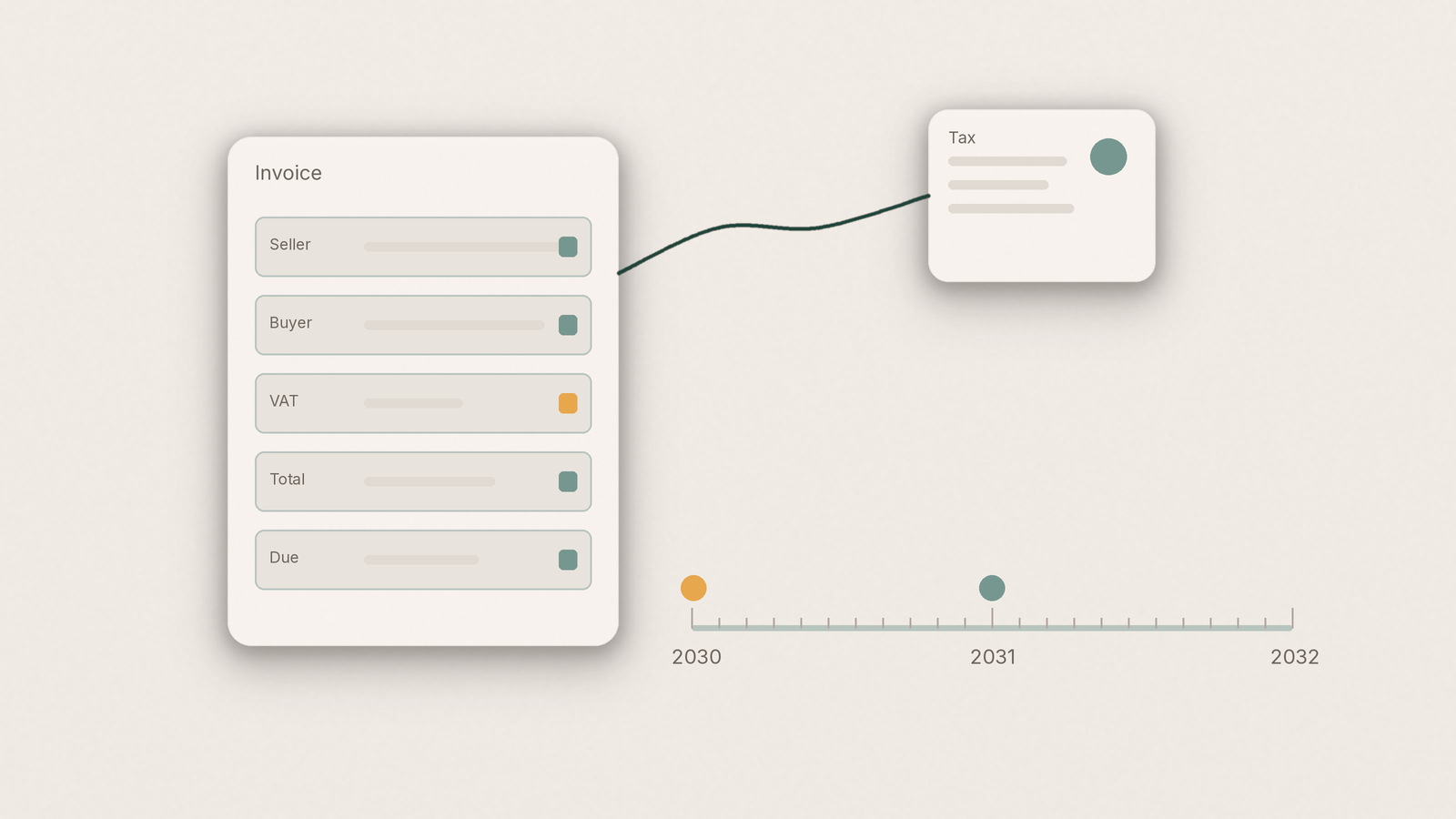
A PDF looks structured to a person, but to software it is a picture of a page. An OCR tool can guess at the supplier name and the total. A structured e-invoice carries each field as data: seller, buyer, VAT number, line items, VAT per rate, amount due.
Three terms come up in every article on this topic:
- ViDA stands for VAT in the Digital Age. It is an EU directive, , adopted on 11 March 2025. It makes e-invoicing and near real-time digital reporting the rule for cross-border B2B sales inside the EU from 1 July 2030, and lets each member state add domestic B2B.
- EN 16931 is the European standard for the core data of an electronic invoice. The 2017 version is being replaced by EN 16931-1:2026, and the European Commission says the 2017 version stays compliant during a migration period.
- Digital reporting means sending data from each invoice to the tax authority as the invoice is issued, instead of summarising it later in a return. For EU cross-border sales it replaces the current ICP return.
Which dates matter for a finance team?
The government has chosen to apply e-invoicing to domestic B2B sales as well, as France, Germany, Belgium, Poland and Italy also plan to. The reporting duty for domestic sales comes a year later.
Dates from the Dutch government's plan and the draft law. They can still change during consultation and in parliament.
Two things stand out. First, 2030 is far enough away that nobody needs to rush a software migration this quarter. Second, the final act is meant to be published by 30 June 2028, which leaves about two years between certainty and the start date. If you buy finance software before then, ask about e-invoicing first, because a system chosen in 2027 will still be running in 2030. Business.gov.nl gives the same advice.
How does one invoice change under the draft?
Take a cross-border sale to a customer in another EU country. Under the draft, the supplier issues a structured e-invoice within 10 days and reports its data to the Belastingdienst when it is issued. The buyer reports the purchase within five days of receiving the invoice.
A process diagram based on the draft law, not survey data. For domestic sales, reporting starts on 1 July 2031 and, according to the draft, falls on suppliers only.
Here is how the main points compare with today. The right-hand column is the draft, not the final law.
The 10-day rule deserves more attention than it is getting. Many companies invoice in a batch at month end. Under the draft, an invoice for work delivered on the 3rd is late on the 14th. That is a process change for operations, who confirm delivery, as much as for finance, who send the invoice.
The directive also lets member states make holding a compliant e-invoice a condition for deducting input VAT. That is a national choice, and we have not seen the Dutch draft make it. Check the final text, since it would turn a badly formatted supplier invoice into a VAT cost for you.
What should a finance or operations lead do before 2030?
You do not need a project plan yet. A few small steps now will save a rushed year later.
- Count your invoice streams. List how invoices leave and arrive: your own invoicing tool, your accountant's system, marketplace payouts, supplier portals, PDFs in a shared inbox. Most companies find two or three streams they had forgotten.
- Ask each supplier and software vendor one question. "Which e-invoice format do you support, and from when?" Business.gov.nl suggests the same. Keep the answers in one table.
- Check your delivery-to-invoice gap. Take last month's invoices and measure the days between delivery or completion and the invoice date. If the typical gap is longer than 10 days, find out where the time goes. It is usually a missing confirmation from operations (see our ).
- Clean up the data that feeds the invoice. A structured invoice needs correct VAT numbers, legal names and addresses for every customer. Errors that a person ignores will fail a validator. Our article lists what to verify.
- Respond to the consultation if it affects you. It is open to anyone until 16 December 2026 on . Public responses are listed on that page.
- Revisit in mid-2027. When the bill reaches the Tweede Kamer, the text is close to final. That is the time to budget.
If you receive a lot of supplier invoices, also look at how they are approved. Structured data makes automatic checks easier, but someone still has to decide whether a bill should be paid. We covered that in .
Where does Klarora fit?
Klarora by Kairos is a workspace that includes a finance module, so the invoice and the work behind it can sit in one place. Each legal entity has its own intake address for supplier documents, OCR reads them, duplicates are flagged, and a person posts the entry. Quotes and invoices can be created from a customer record, as described in the . The module is on the .
One thing to say clearly: Klarora's finance pages do not currently state support for EN 16931 structured e-invoices, so we are not claiming it here. If your timeline needs it, ask us through the and judge any vendor, including us, on a written answer and a date.
Klarora is made by Kairos Connect B.V. in Amsterdam and hosted in the EU. This article is general information, not tax advice. Check details with your accountant and the Belastingdienst.
Questions finance leads ask about Dutch e-invoicing
When does e-invoicing become mandatory in the Netherlands?
The draft law sets 1 July 2030 for e-invoicing between businesses, domestic and cross-border, and for digital reporting of cross-border sales. Digital reporting of domestic sales starts on 1 July 2031. The law is not final, so treat the dates as the current plan.
Is a PDF invoice still allowed after 2030?
Not for business-to-business invoices that fall under the mandate. Business.gov.nl states that a PDF sent by email does not meet the European standard. The draft allows a hybrid invoice, which carries extra data alongside the structured part, but the structured data must be there.
Does the small business scheme (KOR) have to use e-invoicing?
No. Dutch companies in the KOR, with turnover up to €20,000 a year, are exempt from the e-invoicing and reporting duties, and the government says that exemption continues after 2030. A 50 to 200 person company will not be in this group.
What is the 10-day invoicing rule?
Under the draft, a supplier must issue the invoice within 10 calendar days after the taxable event, which is usually the delivery or the completion of the service. Today the deadline is the 15th of the month after the sale.
Do I need to do anything before the law passes?
You do not need to buy anything yet. Map your invoice flows, ask your suppliers and software vendors which formats they will support, and measure your delivery-to-invoice time. Revisit when the bill reaches parliament.
Sources
- Rijksoverheid.nl, (11 September 2026)
- Overheid.nl, (18 November to 16 December 2026)
- Business.gov.nl,
- KPMG, (23 November 2026)
- Thomson Reuters, (24 November 2026)
- EUR-Lex,
- European Commission,