
For companies whose financial year ends on 31 December, this is stock count month. In many warehouses that still means stopping shipments for a day or two, handing out count sheets to people from sales and finance, and hoping nobody has to recount aisle 4 on New Year's Eve.
Cycle counting spreads that work over the year in small weekly slices. The year-end count gets smaller, and differences turn up while there is still time to fix their cause.
In short: cycle counting means counting a small set of stock items every week, so that every item is counted at least once a year and valuable items more often. Done well, with differences investigated and the plan agreed with your auditor in advance, it can shrink or replace the full count at year end. A typical setup ranks items by value into A, B and C classes, counts A items monthly, B quarterly and C once a year, and reviews every difference before stock is adjusted.
What is cycle counting?
Cycle counting is a stock count procedure in which you count part of your inventory on a fixed schedule instead of everything on one day. Over a year, every item gets counted at least once.
It needs a perpetual inventory: stock records updated every time goods arrive, leave or move between locations. Each count tests those records. When a count disagrees, something in receiving, picking or moving goods has gone wrong, and the count shows you where.
A full count gives you one corrected number in January. Cycle counting gives you causes all year: a delivery booked two days late, a picker using the wrong bin, cable bought per roll and stored per metre.
Can cycle counts replace the year-end stock count?
Often, on terms your auditor accepts. A Dutch company is medium-sized when it meets two of three KVK size criteria two years running, one being 50 to 250 employees, and medium-sized companies file their accounts with an auditor's report. So plenty of 50–200 person companies have an auditor looking at their stock.
The auditing standard on inventory, ISA 501, expects the auditor to attend a physical count when stock is material. It allows counts on dates other than year end if movements up to the balance sheet date are properly recorded, and it warns that differences between records and counts can mean the controls over stock movements are not working.
The ICAEW puts the practical version plainly: where every item is counted at least once a year, records are kept up to date and those controls have been tested and work, only limited testing may be needed at year end.
For cycle counts to stand in for the big count, the programme needs to:
- reach every item at least once in the financial year;
- keep stock records current, including receipts and transfers;
- investigate differences and write down the cause;
- let the auditor watch some counts and do their own test counts.
Agree the plan with your auditor before you rely on it. Telling them in January usually ends in a full count anyway.
How do you decide what to count, and how often?
Rank your items by annual usage value: units used in a year times unit cost. A small group usually carries most of the value. A common rule of thumb puts the top 80% of value in class A, the next 15% in B and the last 5% in C, then counts A monthly, B quarterly and C once a year. Use it as a starting point and adjust.
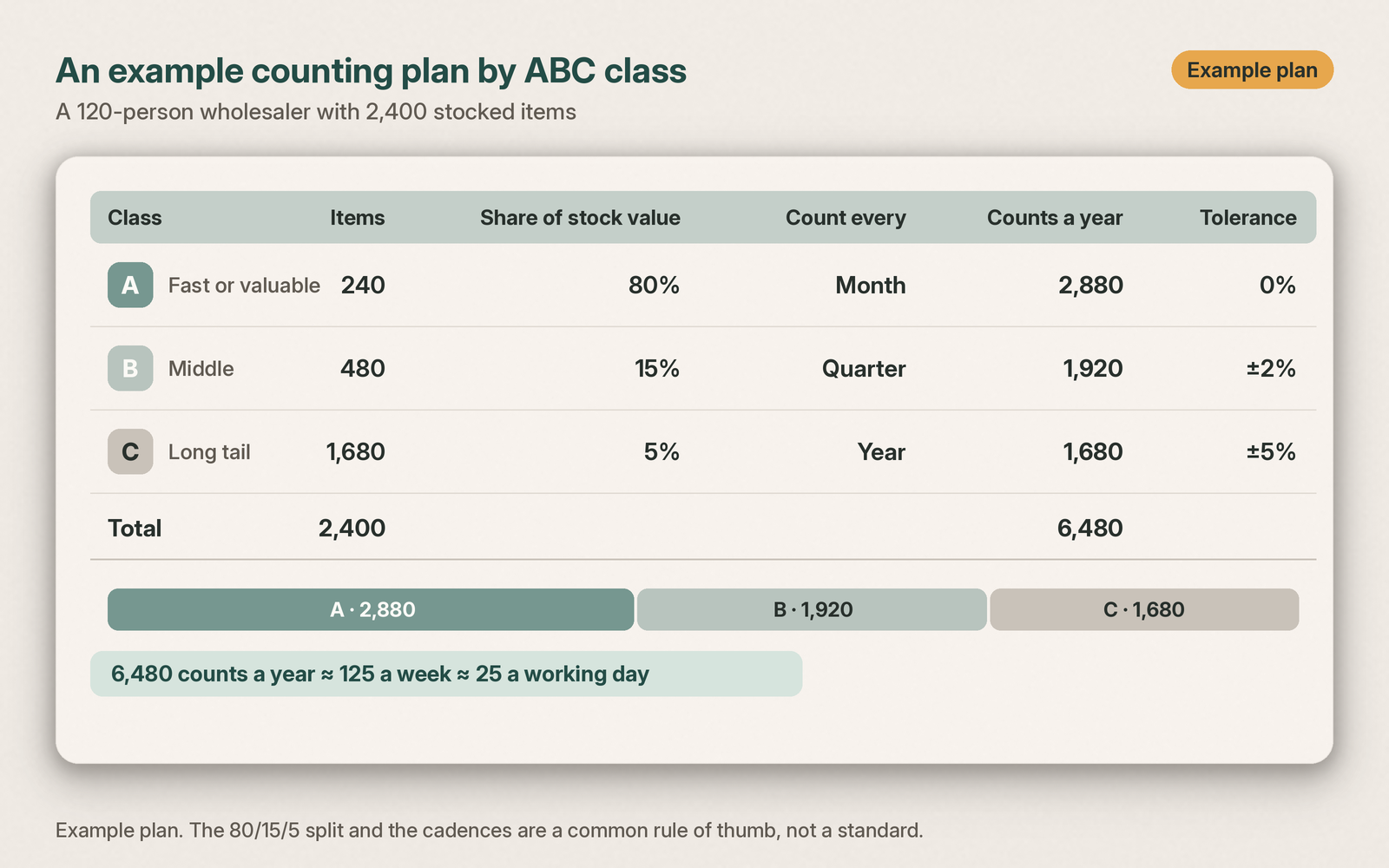
Illustration with example figures: an ABC counting plan for a 120-person wholesaler with 2,400 stocked items.
In this example the plan comes to 6,480 counts a year: about 125 a week, or 25 per working day.
Promote items that value alone ranks too low: fast pickers, theft-prone goods and parts that hold up a key customer's order. Re-rank at least twice a year, because demand moves and a stale class list counts the wrong things.
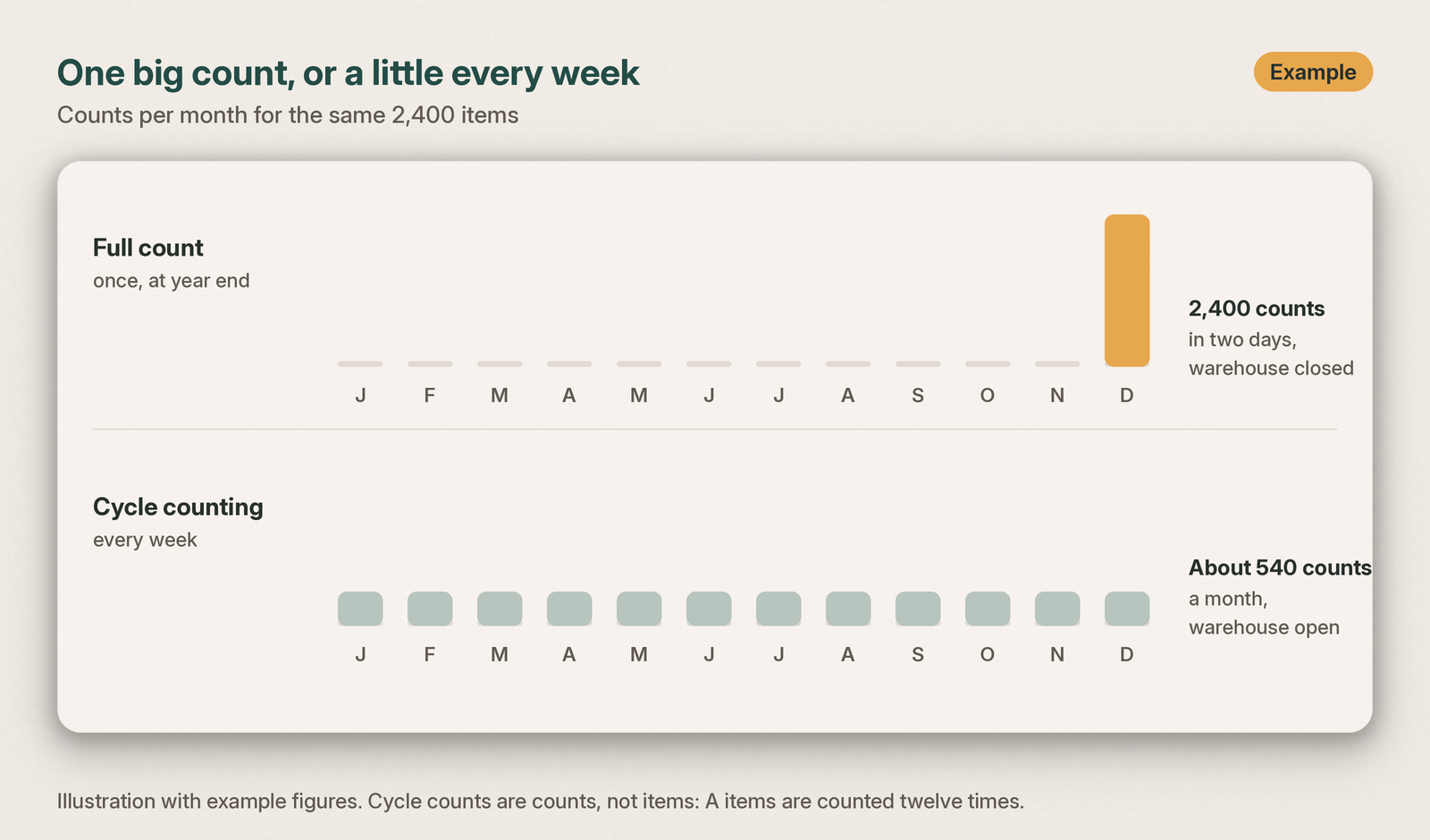
Illustration with example figures: the same items counted in one December peak, or in about 540 counts a month.
What does a weekly cycle count look like?
Fix the day, the list format and the people, so the routine still runs in a busy quarter.
- Monday, before picking starts: build the week's list from the class plan, sorted by location so the counter walks one route.
- Count blind. The counter sees location, item and unit, never the expected quantity. People who can see the number tend to find it.
- Compare with the records and flag lines outside the class tolerance.
- Recount flagged lines with a second person, the same day, before stock moves again.
- Find the cause of each remaining difference.
- Approve and post adjustments: small ones by the warehouse lead, larger ones by operations or finance, with the cause noted.
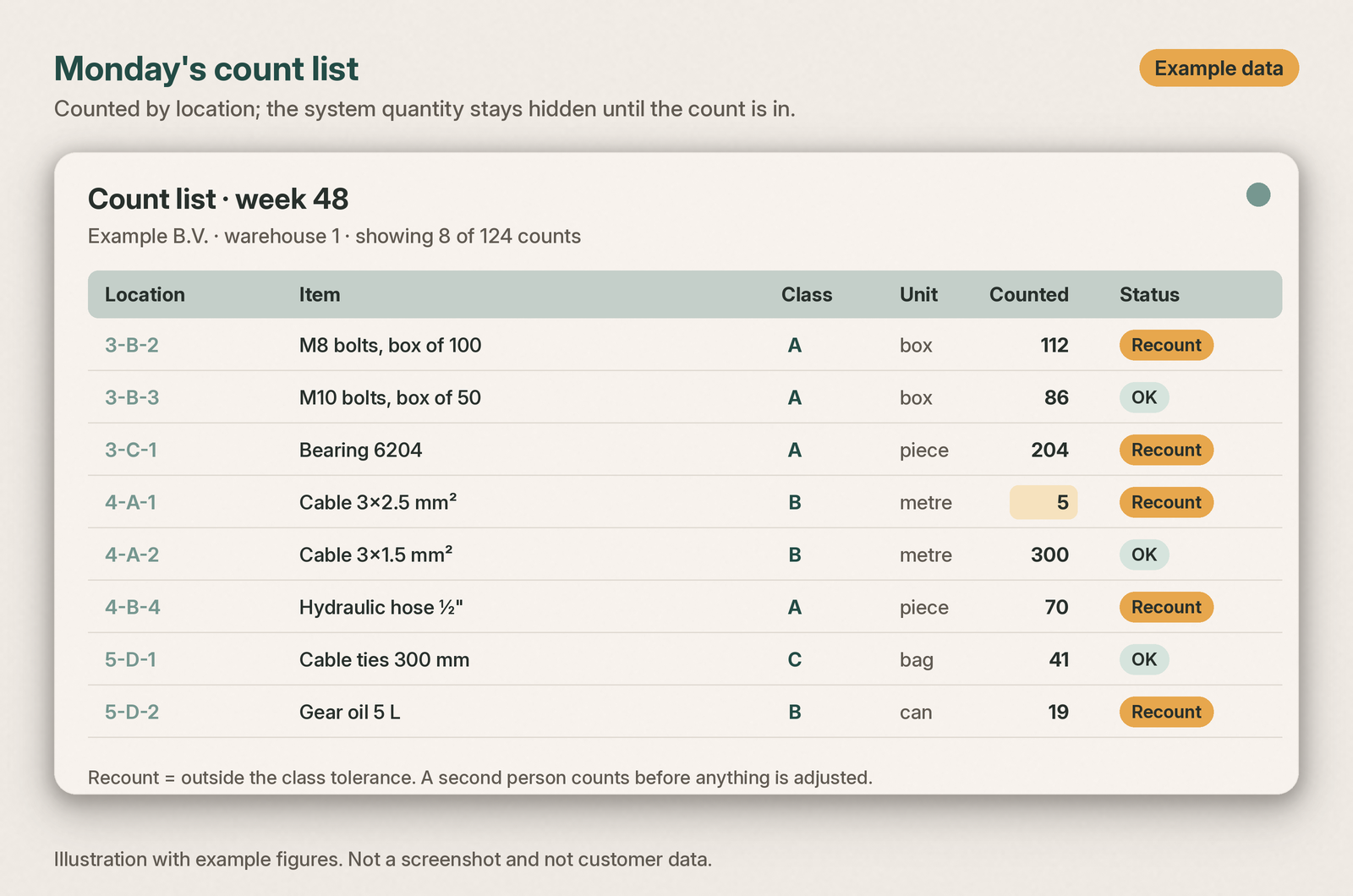
Illustration with example figures: a count list sorted by location, with the expected quantity hidden from the counter.
If you cannot count before picking, freeze the counted locations for the few minutes it takes. Goods that move during a count create differences that are not real.
What do you do with a difference?
Find the cause before anyone adjusts. An adjustment corrects this week's number and leaves the cause in place for next week. Most differences fall into a few groups:
| Cause | What you see | Fix |
|---|---|---|
| Unit of measure | Counted 5, system says 500 | Count in the stock unit; label the bin with it |
| Late or missed receipt | More on the shelf than in the system | Book receipts on arrival; check the delivery cut-off |
| Wrong location | Zero here, the same quantity elsewhere | Transfer in the system; fix the putaway habit |
| Pick not booked | Less on the shelf, no matching order | Book picks and samples when they happen |
| Damage or loss | Less on the shelf, goods unusable or gone | Write off with approval; look for a pattern |
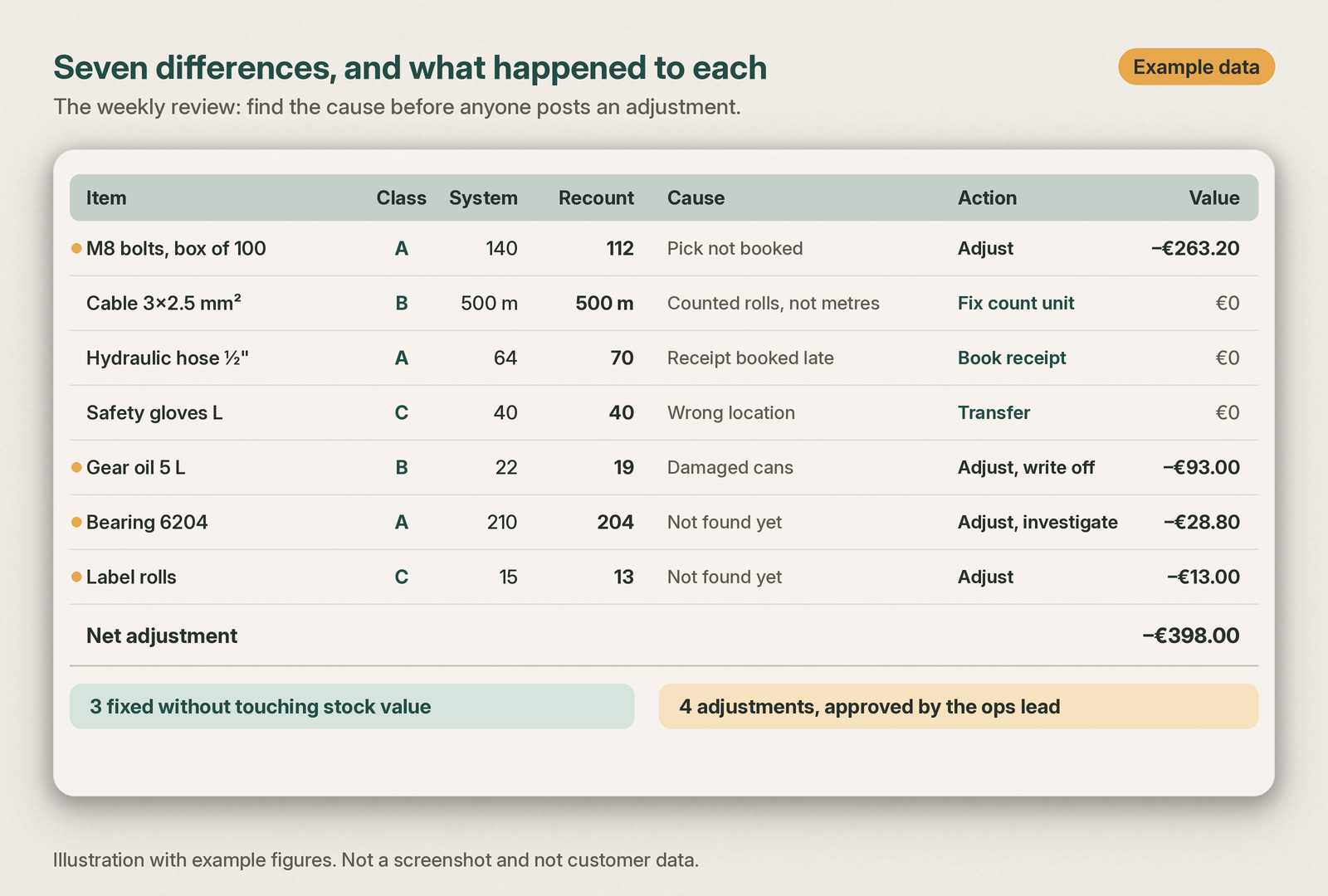
Illustration with example figures: seven differences, three fixed without touching stock value and four adjustments worth −€398.00 net.
Send finance the adjustments every week. Each one changes the stock value in the books, and repeated small write-offs on the same items deserve a conversation before the auditor asks. Late receipts are also a month-end cut-off issue; see why stock values and the books drift apart.
How do you know the programme is working?
Track a few numbers weekly and watch the trend over several weeks. Inventory record accuracy is the simplest: counts within tolerance divided by all counts. Read it per class, because a good overall figure can hide a poor A class.
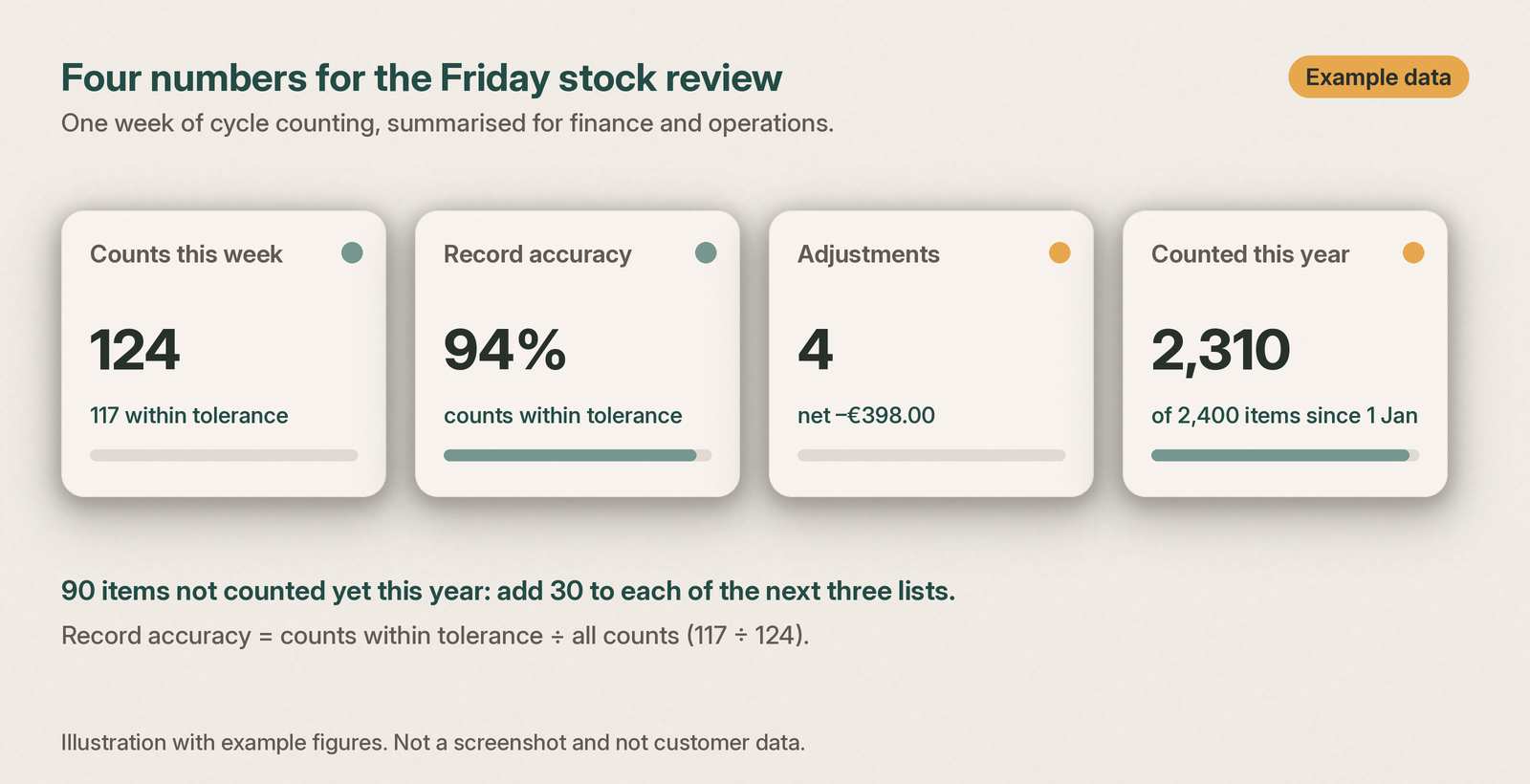
Illustration with example figures: four numbers for a Friday stock review, here 94% record accuracy and 90 items still to count this year.
Coverage matters most in the last weeks of the year. If 90 items have not been counted since January, put them on the next lists now.
A checklist before 31 December
- Ask your auditor which counts they want to attend, and whether cycle counts reduce the year-end count.
- List items not yet counted this financial year and schedule them before the closing date.
- Book all receipts, transfers and returns up to the count date; agree the cut-off rule for deliveries in transit.
- Write down the count instructions: blind counts, recount rule, who approves which adjustments.
- Count damaged and slow-moving stock too, and mark it separately for valuation.
- Reconcile the counted stock value to the stock account in the ledger as part of your month-end close.
Where Klarora by Kairos fits
The plan above works with any system that keeps stock records per location. If your team already works in Klarora, the Supply add-on covers the record side: stock by location, transfers between shelves, and posting the difference after a physical count, with a record for each movement. Items can be bought in one unit and counted in another (a roll bought whole, counted by the metre), which removes a common source of false differences. Barcode labels cover items, lots and locations, and goods are scanned on receipt. Reports show stock that has stopped moving and turnover, useful when you re-rank classes.
Supply does not advertise automatic ABC classification or a cycle count scheduler, so keep the class list and weekly plan in a table your team owns. Supply is an Ultimate add-on at €119 per seat per month and can sync stock entries to Klarora Finance. For receiving against purchase orders, see the three-way match.
Frequently asked questions
What is the difference between cycle counting and a full stock count?
A full count checks every item on one day, usually with operations stopped. Cycle counting checks a small set each week, reaching every item at least once a year while the warehouse keeps running.
How often should you cycle count?
A common starting point is monthly for A items, quarterly for B items and once a year for C items, based on annual usage value. Adjust it to the counting time you have and to items that cause frequent errors.
Do auditors accept cycle counting instead of a year-end count?
Often, if every item is counted at least once in the year, records are current, differences are investigated and the auditor can attend some counts. Agree it with your auditor in advance.
How do you calculate inventory record accuracy?
Divide the number of counts within tolerance by the total number of counts. In the example above, 117 of 124 counts were within tolerance, so record accuracy was 94%. Track it per ABC class.
Klarora is made by Kairos Connect B.V. in Amsterdam and hosted in the EU.